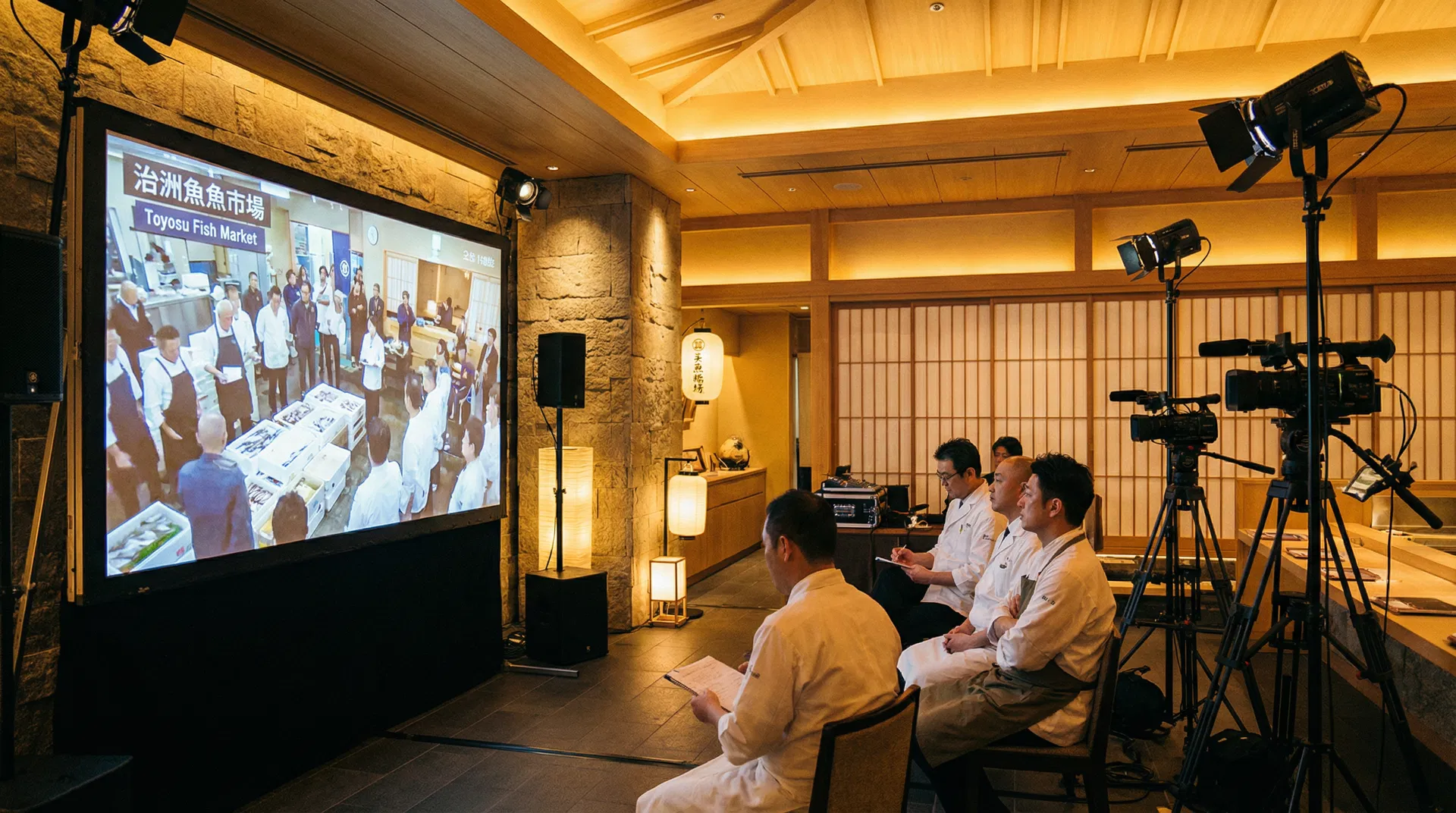
Every morning at 5:30 AM Tokyo time, a bell rings inside the cavernous auction hall of Toyosu Market, and the world's most important seafood auction begins. Within the next 60 minutes, hundreds of millions of yen will change hands as licensed buyers compete for the finest tuna, sea bream, flounder, and dozens of other species that will grace the plates of Japan's most prestigious restaurants by lunchtime.
But Toyosu's reach extends far beyond Tokyo. Through a sophisticated network of air freight logistics, the same fish that a Ginza sushi master selects at 6 AM can arrive in a Vancouver kitchen by the following evening. This article takes you behind the scenes of this remarkable supply chain, from the auction floor in Tokyo to your cutting board in Canada, and explains why direct Toyosu sourcing represents the ultimate competitive advantage for Canadian chefs.
The History and Significance of Toyosu Market
Toyosu Market opened in October 2018 as the successor to the legendary Tsukiji Market, which had served as Tokyo's central wholesale market since 1935. Located on a 40-hectare site in Tokyo's Koto Ward, Toyosu is the largest wholesale fish market in the world, handling approximately 480 different species of seafood and processing over 1,600 tonnes of product daily.
The move from Tsukiji to Toyosu was not merely a change of address, it represented a fundamental modernization of Japan's seafood distribution infrastructure. Toyosu features fully enclosed, temperature-controlled auction halls (Tsukiji's were open-air), advanced hygiene systems including air curtains and sealed loading docks, HACCP-compliant processing facilities, and real-time temperature monitoring throughout the facility. These improvements directly benefit international buyers like True World Foods, because they ensure that the cold chain begins at the very first point of commercial handling.
How the Tuna Auction Works
The tuna auction is Toyosu's most famous event, and understanding how it works illuminates the quality standards that govern Japan's entire seafood industry. The process begins the evening before, when tuna from fishing vessels and farms across Japan (and sometimes internationally) arrive at the market. Each fish is tagged with its origin, weight, catch method, and the seller's information.
Licensed market inspectors then examine each tuna using a specialized technique. They cut a small cross-section from the tail, which reveals the color, fat content, and texture of the flesh. Experienced inspectors can assess a tuna's quality in seconds by examining this cross-section under fluorescent light. They are looking for: deep, consistent red color indicating proper bleeding and handling; visible fat marbling (sashi) that indicates the fish's condition and diet; firm, elastic texture that suggests freshness; and absence of any off-colors, bruising, or parasitic indicators.
The next morning, licensed buyers, representing restaurants, retailers, and distributors, inspect the tuna on the auction floor using flashlights and their own expertise. The auction itself uses a unique hand-signal bidding system where buyers flash numbers with their fingers in rapid succession. The entire process for a single fish takes less than 30 seconds. Top-grade bluefin tuna regularly sells for $100-$300 per kilogram at auction, with the famous New Year's first auction (hatsu-seri) commanding ceremonial prices that can exceed $3,000 per kilogram.
Beyond Tuna: The Full Scope of Toyosu
While the tuna auction captures headlines, Toyosu Market handles an extraordinary diversity of seafood. The market is organized into three main buildings: the Fisheries Wholesale Market Building (where auctions occur), the Fisheries Intermediate Wholesale Market Building (where licensed wholesalers sell to buyers), and the Fruit and Vegetable Market Building.
The intermediate wholesale area is where the real business happens for international distributors. Here, over 500 licensed wholesalers (known as nakaoroshi) operate stalls specializing in specific categories: shellfish, white fish, red fish, processed products, dried goods, and more. These wholesalers have deep expertise in their categories and long-standing relationships with the best fisheries across Japan.
True World Foods maintains dedicated buying staff at Toyosu who have cultivated these relationships over decades. When a particularly exceptional lot of uni arrives from Hokkaido, or when the first katsuo of the season comes in from Kochi Prefecture, our buyers know about it, often before it even reaches the auction floor. This insider access is something that cannot be replicated by distributors who source through intermediaries.
From Toyosu to Canada: The 48-Hour Journey
The logistics of moving fresh fish from Tokyo to Vancouver, Calgary, Toronto, or Montreal within 48 hours is a feat of precision planning that involves multiple partners, strict protocols, and zero margin for error. Here is how the journey unfolds:
Hours 0-4 (Toyosu Market, Tokyo): Our buyers complete their purchases by 7 AM. Selected fish is immediately transported to our Tokyo packing facility in temperature-controlled vehicles. At the packing facility, each item is inspected, portioned if necessary, and packed in custom insulated containers with calibrated gel packs designed to maintain 0-2°C for up to 72 hours. Temperature data loggers are placed in every shipment.
Hours 4-8 (Tokyo to Narita/Haneda Airport): Packed shipments are transported to the airport and processed through export customs. Japan's export inspection system verifies species identification, health certificates, and packaging compliance. Our logistics team coordinates with airline cargo departments to ensure priority loading and temperature-controlled holding areas.
Hours 8-20 (Air Transit): Direct flights from Tokyo to Vancouver take approximately 9 hours. For Eastern Canadian destinations, connecting flights add 4-6 hours. Throughout the flight, cargo holds maintain temperatures between 2-8°C. Our routing algorithms select flights based on departure times, transit temperatures, and arrival schedules to minimize total transit time.
Hours 20-30 (Canadian Arrival and Customs): Upon arrival in Canada, shipments are processed through CFIA inspection. Our customs brokerage team pre-clears documentation to minimize holding time. Once released, shipments are immediately transferred to our temperature-controlled distribution centers.
Hours 30-48 (Distribution to Your Kitchen): From our distribution centers in Vancouver, Calgary, Toronto, Montreal, and Quebec City, our own fleet of refrigerated trucks delivers directly to your restaurant. Delivery schedules are coordinated to ensure you receive your fish at the optimal time for your prep schedule.
The JapanFish Express Advantage
Our JapanFish Express service was designed specifically for chefs who demand the absolute freshest fish from Japan. Unlike standard import channels where fish may pass through multiple intermediaries and cold storage facilities, JapanFish Express operates on a direct pipeline: Toyosu Market to your kitchen, with no intermediate warehousing.
The service includes three weekly shipments (Monday, Wednesday, Friday arrivals in Western Canada; Tuesday, Thursday, Saturday in Eastern Canada), priority access to seasonal specialties and limited-availability species, real-time tracking with temperature monitoring accessible via our client portal, and a dedicated account manager who can accommodate special requests and last-minute additions.
For omakase programs and high-end sushi bars, JapanFish Express is not just a logistics service, it is a competitive weapon. When you can tell your guests that the hirame on tonight's menu was swimming in Japanese waters 36 hours ago, you are offering an experience that the vast majority of restaurants in Canada simply cannot match.
What This Means for Your Restaurant
Access to Toyosu Market through a trusted distributor transforms your sourcing capabilities in several concrete ways. First, it expands your menu possibilities. Species that are unavailable through domestic Canadian suppliers, like nodoguro (blackthroat sea perch), kinmedai (splendid alfonsino), or seasonal specialties like shirako (cod milt), become accessible, allowing you to offer a truly authentic Japanese dining experience.
Second, it elevates your quality ceiling. The grading standards at Toyosu are the most rigorous in the world. Fish that passes Toyosu's quality threshold is, by definition, among the finest available anywhere. When you source through Toyosu, you are benchmarking your quality against the same standard used by three-Michelin-star restaurants in Tokyo.
Third, it strengthens your brand story. In an era where diners increasingly care about provenance and authenticity, being able to trace your fish to a specific auction at Toyosu Market is a powerful differentiator. It demonstrates a commitment to quality that resonates with both Japanese food enthusiasts and general fine-dining guests.
To learn more about how Toyosu Market sourcing can elevate your restaurant's seafood program, contact our team for a complimentary consultation. We will assess your current needs, recommend a sourcing strategy, and provide samples so you can experience the Toyosu difference firsthand.