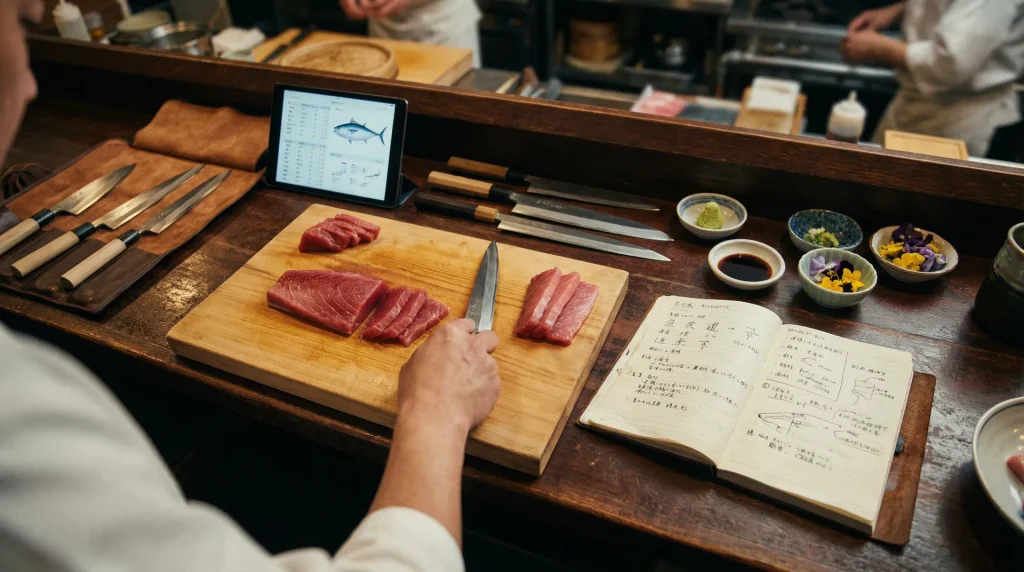

Food cost management in Japanese cuisine presents unique challenges that simply do not exist in most Western restaurant models. When your signature dish requires A5 wagyu at $280 per kilogram or wild bluefin otoro at $200 per kilogram, the traditional food cost percentage targets that work for a steakhouse or Italian trattoria become meaningless without context. The key to profitability in Japanese fine dining is understanding value-based costing rather than chasing arbitrary percentage targets.
This guide provides a data-driven framework for managing food costs in Japanese restaurants, covering everything from yield calculations and seasonal purchasing strategies to portion control techniques and technology solutions. Whether you operate a high-volume sushi bar or an intimate omakase counter, these principles will help you protect your margins without compromising the quality that defines your brand.
Rethinking Food Cost Percentages for Japanese Cuisine
The standard restaurant industry target of 28-32% food cost is a useful benchmark for casual dining, but it does not apply uniformly to Japanese fine dining. An omakase program might run 40-45% food cost and still achieve strong profitability through higher check averages, lower labor costs per cover (since the chef is both cook and server), and premium beverage pairings that carry 15-20% cost ratios.
The metric that truly matters is contribution margin per seat per hour, not food cost percentage alone. Consider this example: a sushi bar seat generating $150 per cover with 40% food cost yields $90 in contribution margin. A casual dining seat generating $45 per cover with 30% food cost yields only $31.50 in contribution margin. The 'expensive' sushi program is nearly three times more profitable per seat.
This reframing is essential for Japanese restaurant operators. Instead of asking 'How do I get my food cost below 30%?', the better question is 'How do I maximize the contribution margin of every seat in my restaurant?' This shift in thinking opens up strategic options that percentage-focused management misses entirely.
Yield Calculation: Where Most Restaurants Lose Money
Yield calculation is where the majority of Japanese restaurants lose money without realizing it. The gap between what you pay for and what you can actually serve is significant, and it varies dramatically by species, cut, and preparation method.
A whole bluefin tuna might have a 45% usable yield for premium sashimi cuts (akami, chutoro, otoro). But the remaining 55% is not waste, it is opportunity. The collar (kama) can be grilled and sold as a premium appetizer. The belly trim can be used for negitoro (minced tuna with scallion). The cheek meat makes exceptional tartare. The bones produce a rich stock for miso soup. Restaurants that develop creative applications for every part of the fish routinely achieve effective yields of 80-85%, transforming what appears to be a high-cost ingredient into a highly profitable one.
Here are benchmark yield percentages for commonly purchased whole fish in Japanese restaurants: Bluefin Tuna yields approximately 45% for sashimi cuts, with an additional 30-35% usable for secondary preparations. Salmon yields approximately 60% for sashimi fillets, with belly trim usable for aburi (torched) preparations. Hamachi yields approximately 55% for sashimi, with collar and belly highly valued. Tai (Sea Bream) yields approximately 45% for sashimi, with the head prized for tai no kabutoni. Hirame (Flounder) yields approximately 40% for sashimi, with engawa (fin muscle) considered a delicacy.
The critical practice is to calculate your true cost per usable gram, not per kilogram purchased. If you buy hamachi at $40/kg with a 55% sashimi yield, your true sashimi cost is $72.73/kg of usable product. If you can sell the collar for $18 per portion (using approximately 200g), that revenue offsets your sashimi cost and brings the effective price closer to $55/kg. This kind of whole-fish utilization thinking is the difference between a profitable Japanese restaurant and one that struggles with margins.
Seasonal Purchasing Strategy
Fish prices fluctuate 30-50% based on season, weather, and market conditions. By building your menu around seasonal availability rather than fixed offerings, you can maintain, or even improve, quality while significantly reducing costs. This is not just a cost management strategy; it is also an authenticity strategy, since seasonal eating (shun) is a cornerstone of Japanese culinary philosophy.
Spring (March-May) brings excellent value on tai (sea bream), sawara (Spanish mackerel), and hotaru ika (firefly squid). These species are at peak quality and abundant supply, creating a favorable price-quality ratio. Summer (June-August) is prime season for uni (sea urchin), anago (conger eel), and ayu (sweetfish). While uni prices remain high due to global demand, the quality peak means you are getting maximum flavor per dollar. Autumn (September-November) delivers exceptional sanma (Pacific saury), sake (salmon), and katsuo (bonito). This is often the most cost-effective season for building a diverse sashimi program. Winter (December-February) is the premium season for buri (yellowtail), fugu (pufferfish), and tara (cod). Buri in particular reaches its peak fat content and flavor during winter months.
Our JapanFish Express service provides weekly market reports from Toyosu that include current pricing trends, availability forecasts, and seasonal recommendations. Using this intelligence to plan your menu two to four weeks ahead allows you to lock in favorable pricing and build anticipation with your guests through seasonal menu announcements.
Precision Portion Control
Portion control in Japanese cuisine requires a level of precision that goes beyond simple weight measurements. A 30-gram difference in a sashimi portion might seem minor, but across 100 covers per night, that variance represents 3 kilograms of premium fish, potentially $450 or more in daily cost variance. Over a month, that is $13,500 in uncontrolled cost.
The solution is standardization through tools and training. Invest in precision digital scales (accurate to 1 gram) at every cutting station. Create laminated cutting guides that show exact portion sizes for each dish. Develop standardized plate presentations that make over-portioning visually obvious. And conduct regular portioning audits where you weigh 10 random portions of each dish and calculate the variance.
For nigiri sushi specifically, the rice portion is equally important. A standard nigiri rice ball should weigh 18-22 grams. A chef who consistently makes 25-gram rice balls is using 15-30% more rice per piece, which compounds across hundreds of pieces per service. Rice portioning jigs and regular training sessions help maintain consistency.
The goal is not to create a rigid, joyless kitchen. It is to establish a baseline of consistency that allows your chefs to focus their creativity on presentation and flavor rather than guessing at portions. The best sushi restaurants in the world are also the most precise.
Menu Engineering for Maximum Profitability
Menu engineering, the strategic analysis of menu item profitability and popularity, is particularly powerful in Japanese restaurants because of the wide range of ingredient costs. The classic menu engineering matrix categorizes items into four quadrants: Stars (high profit, high popularity), Plowhorses (low profit, high popularity), Puzzles (high profit, low popularity), and Dogs (low profit, low popularity).
In a Japanese restaurant context, your Stars might include items like salmon aburi roll (moderate ingredient cost, high perceived value), edamame and gyoza appetizers (very low cost, universally popular), and premium sake by the glass (high margin, strong demand). Your Plowhorses might include chirashi bowls (high ingredient cost due to variety, but a customer favorite) and lunch sashimi sets (competitive pricing limits margin).
The strategic moves are: promote Stars aggressively through menu placement and server recommendations; re-engineer Plowhorses by adjusting portion sizes, substituting ingredients, or raising prices incrementally; invest in marketing Puzzles to increase their popularity; and either eliminate Dogs or transform them into higher-margin items.
One particularly effective technique for Japanese restaurants is the 'omakase upsell', offering a chef's choice upgrade at a fixed premium. This allows you to use the freshest, highest-margin ingredients of the day while creating an experience that guests perceive as exclusive and premium. The chef controls both cost and quality, and the guest feels special. It is a rare win-win in restaurant economics.
Technology Solutions for Inventory Management
Modern point-of-sale and inventory management systems have matured significantly, and the investment in proper technology typically yields 3-5% food cost reduction within the first quarter. Key features to look for include: ingredient-level cost tracking per dish (not just category-level), automatic purchase order generation based on par levels and sales forecasts, real-time food cost reporting by day, week, and period, waste tracking with reason codes (spoilage, over-prep, returns), and integration with your supplier's ordering system for streamlined procurement.
For Japanese restaurants specifically, look for systems that can handle the complexity of whole-fish purchasing with multiple yield outputs, seasonal menu rotations with automatic cost updates, and multi-unit pricing (per piece, per gram, per kilogram). The initial setup requires careful recipe costing, but once established, the system provides visibility that manual tracking simply cannot match.
The data from these systems also strengthens your supplier negotiations. When you can show your distributor exactly how much of each species you purchase monthly, your seasonal trends, and your growth trajectory, you become a more valuable customer, and valuable customers get better pricing, priority allocation during shortages, and access to premium products that smaller buyers never see.
Putting It All Together: A 90-Day Action Plan
Implementing comprehensive food cost management does not happen overnight, but you can make meaningful progress in 90 days. In the first 30 days, focus on measurement: conduct a complete yield test for your top 10 ingredients, audit your current portioning practices, and establish your true food cost baseline. In days 31-60, focus on optimization: implement standardized portioning tools, develop secondary preparations for trim and off-cuts, and begin seasonal menu planning using market intelligence. In days 61-90, focus on systems: evaluate and implement inventory management technology, establish weekly food cost review meetings, and create a supplier scorecard that tracks quality, pricing, and service.
True World Foods Canada supports our restaurant partners throughout this process. Our business development team can provide yield data for every product we sell, seasonal pricing forecasts to support your menu planning, and introductions to technology partners who specialize in Japanese restaurant operations. Contact us for a complimentary food cost consultation, we will review your current purchasing and identify specific opportunities to improve your margins.