
The Unseen Journey of Perfect Seafood
For a chef, the quality of an ingredient is non-negotiable. When it comes to seafood, that quality is inextricably linked to a journey that begins the moment it leaves the water. This journey, often invisible to the final consumer, is governed by the rigorous science of cold chain management. It’s a continuous, temperature-controlled supply chain that ensures the seafood you plate is as fresh, safe, and delicious as it was at its point of origin. From the ocean to your kitchen, every step is a critical link in a chain where a single break can compromise the integrity of the product. Understanding this process is not just about food safety; it’s about respecting the ingredient and delivering an unparalleled dining experience. For Canadian restaurants dedicated to excellence, mastering the principles of the cold chain is as crucial as the final preparation of the dish itself.
This guide delves into the science behind keeping seafood perfect. We’ll explore the critical temperature zones, the microscopic changes that occur when temperatures fluctuate, and the technologies and practices that define modern cold chain logistics. We will also highlight how partners like True World Foods Canada leverage their dedicated infrastructure, including their own fleet of temperature-controlled trucks, to maintain an unbroken cold chain. More importantly, we will provide practical, actionable advice for restaurant professionals on how to manage that final, critical link in the chain: receiving and storing seafood deliveries. By the end, you will have a deeper appreciation for the complex logistics that bring pristine seafood to your door and the knowledge to ensure that quality is preserved until it reaches the plate.
The Science of Freshness: Why Temperature is Everything
To understand the importance of the cold chain, we must first understand what happens to seafood after it is harvested. From the moment a fish is caught, a series of biochemical processes begins, leading to a decline in quality. The primary culprits are enzymatic and bacterial degradation. Naturally occurring enzymes in the fish’s muscle tissue start to break down proteins and fats, a process called autolysis, which softens the texture and alters the flavour. Simultaneously, bacteria present on the fish’s skin, gills, and in its gut begin to multiply, producing the undesirable odours and flavours associated with spoilage. These processes are highly dependent on temperature. The warmer the temperature, the faster these reactions occur.
This is where the concept of the 'temperature danger zone' becomes critical. As defined by food safety authorities, this is the range between 4°C (40°F) and 60°C (140°F), where bacteria can double in number in as little as 20 minutes. For seafood, the focus is on the lower end of this spectrum. Every degree above the ideal holding temperature accelerates the degradation process, reducing shelf life and compromising both safety and quality. Proper cold chain management is, therefore, a race against time, using temperature as the primary tool to slow down these natural processes. By keeping seafood at a consistent, optimal temperature, we can significantly inhibit bacterial growth and enzymatic activity, preserving the firm texture, delicate flavour, and nutritional value that define a premium product.
The Critical Temperature Zones: A Numbers Game for Quality
Fresh Seafood: The 0°C to 4°C Rule
For fresh, unfrozen seafood, the golden rule is to maintain a product temperature as close to 0°C (32°F) as possible without freezing it. The ideal range is between 0°C and 4°C (32°F and 39°F). This temperature range is crucial because it dramatically slows the growth of most spoilage bacteria. While some psychrophilic (cold-loving) bacteria can still grow, their rate of multiplication is significantly reduced. Storing fresh fish in this narrow window maximizes its shelf life, preserving its characteristic firm texture and mild, oceanic aroma. For a restaurant, receiving a delivery of fresh fish that has been maintained within this range means you are starting with the highest quality product possible, allowing for greater flexibility in your menu planning and inventory management.
Maintaining this temperature requires precision at every stage. At True World Foods Canada, this process begins on the docks and continues with our dedicated JapanFish Express fleet. Our trucks are equipped with advanced refrigeration units that ensure a consistent environment is maintained throughout transit, regardless of the external weather conditions. We monitor temperatures continuously to prevent fluctuations that could compromise the product. When you receive a delivery from us, you can be confident that the fish has been held in this critical zone from the moment it was processed, ensuring it arrives in your kitchen in peak condition, ready to be transformed into an exceptional culinary creation.
The Critical Temperature Zones: A Numbers Game for Quality
Frozen Seafood: The -18°C Standard
When it comes to frozen seafood, the internationally recognized standard is to maintain a temperature of -18°C (0°F) or below. This temperature is not arbitrary; it is the point at which the enzymatic and bacterial activity that causes spoilage is effectively halted. While freezing does not kill all bacteria, it puts them into a dormant state, preventing them from multiplying and causing decay. Furthermore, at -18°C, the water within the seafood is completely frozen, which is critical for preserving texture. This prevents the movement of water molecules and slows down oxidative processes that can lead to off-flavours and aromas, commonly known as freezer burn. A consistent, deep-frozen state is the key to long-term preservation without sacrificing quality.
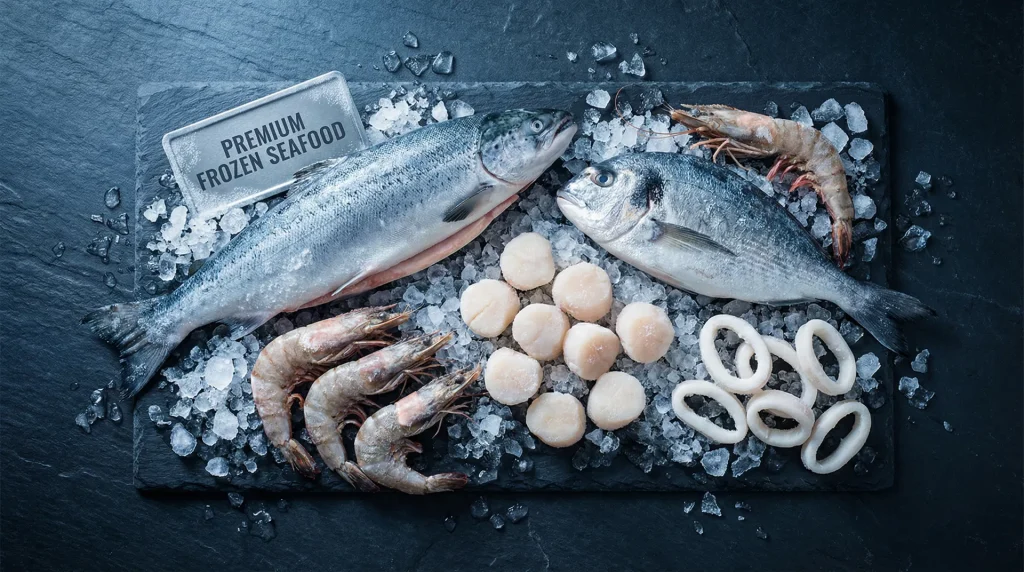
Achieving and maintaining this standard requires a robust and uninterrupted cold chain. Any deviation above -18°C, even for a short period, can initiate thawing at a microscopic level, leading to the formation of large ice crystals and subsequent damage to the product’s cellular structure upon refreezing. This is why a reliable supply chain partner is paramount. Our specialized freezer trucks and storage facilities are designed to hold products at a steady -20°C or colder, providing a buffer to ensure the -18°C standard is never breached. This commitment guarantees that the frozen seafood you receive, whether it’s succulent tuna or delicate scallops, retains the cellular integrity, moisture, and flavour it had when it was first frozen.
The Enemy Within: How Ice Crystals Impact Quality
The quality of frozen seafood is largely determined by what happens at a microscopic level during the freezing process. When seafood is frozen, the water within its muscle tissue turns into ice crystals. The size and distribution of these crystals have a profound impact on the final texture and taste of the product. Ideally, seafood should be flash-frozen, a process that freezes it very quickly at extremely low temperatures. This rapid freezing creates very small ice crystals that are evenly distributed throughout the muscle tissue. These micro-crystals cause minimal damage to the cell walls, preserving the integrity of the muscle fibers. When the seafood is later thawed, the small crystals melt and the water is reabsorbed into the tissue, resulting in a product that is firm, moist, and nearly indistinguishable from fresh.
In contrast, slow freezing or temperature fluctuations during storage (thawing and refreezing) lead to the formation of large, jagged ice crystals. These larger crystals rupture the delicate cell walls of the muscle tissue. When the product is thawed, the damaged cells can no longer effectively retain water. This leads to significant moisture loss, a phenomenon known as drip loss, which carries away flavour compounds and nutrients. The result is a product that is dry, mushy, and has a less appealing texture. This is why an unbroken cold chain is so critical for frozen seafood. Even a partial thaw and refreeze can initiate this damaging recrystallization process, permanently degrading the quality of the product before it ever reaches your kitchen.
Beyond Temperature: ATP, K-Value, and Measuring True Freshness
While temperature is the cornerstone of preservation, a more scientific measure of seafood freshness can be found by analyzing the biochemical changes within the fish itself. One of the most important indicators is the degradation of adenosine triphosphate (ATP), the energy-carrying molecule in living cells. After a fish is harvested, its ATP begins to break down into other compounds, such as inosine monophosphate (IMP), which contributes to the desirable umami flavour of fresh fish. Over time, IMP further degrades into inosine and then hypoxanthine. The accumulation of hypoxanthine is associated with the loss of fresh flavour and the development of bitterness. The ratio of these compounds is used to calculate the K-value, a widely used index for determining the freshness of fish. A lower K-value indicates a fresher fish, while a higher K-value suggests it is further along in the spoilage process.
This scientific approach provides an objective measure of quality that goes beyond simple sensory evaluation. For a supplier like True World Foods Canada, managing the factors that influence the K-value is a key part of our quality assurance. By ensuring rapid cooling immediately after harvest and maintaining a strict cold chain, we slow down the rate of ATP degradation. This means that the seafood we deliver not only looks and smells fresh but is also biochemically in its optimal state. For chefs, this translates to a product with superior flavour, a longer shelf life in your own refrigerators, and the confidence that you are serving the very best. It’s a level of quality assurance that can only be achieved through a deep understanding of the science of freshness.
The True World Foods Difference: Mastering the Cold Chain from Ocean to Kitchen
Maintaining the integrity of the cold chain is a complex logistical challenge that requires specialized infrastructure and unwavering commitment. At True World Foods Canada, we have built our reputation on mastering this process. Unlike suppliers who may rely on third-party logistics providers, we operate our own fleet of state-of-the-art, temperature-controlled trucks. This gives us complete control over the environment in which our products are transported, from our distribution centers directly to your restaurant’s door. Our JapanFish Express service is a testament to this commitment, ensuring that even the most delicate, super-frozen tuna is maintained at a precise -60°C to preserve its colour, texture, and flavour.
This control extends to every link in the chain. Our facilities are equipped with advanced monitoring systems that track temperatures 24/7, and our staff are rigorously trained in the best practices of seafood handling. We understand that there is no margin for error. A single temperature fluctuation can compromise an entire shipment, which is why we have invested so heavily in our infrastructure and processes. When you partner with True World Foods Canada, you are not just buying seafood; you are investing in a system designed to deliver unparalleled quality and consistency. This allows you to focus on what you do best: creating exceptional dishes with the confidence that your ingredients are second to none.
A Restaurant's Guide to Receiving Seafood: Your Role in the Final Link
Even with the most robust supply chain, the final link is the handover at your restaurant. Proper receiving procedures are essential to ensure the quality that has been so carefully preserved is not lost at the last moment. The first step is to inspect the delivery immediately upon arrival. Use a calibrated food thermometer to check the temperature of the product. For fresh fish, it should be at or below 4°C (39°F). For frozen items, they should be solid with no signs of thawing, and ideally at -18°C (0°F) or colder. Visually inspect the product for any signs of temperature abuse, such as discolouration, excessive ice crystals on frozen items, or a strong fishy odour, which can indicate spoilage. Reject any product that does not meet these standards.
Once you have accepted the delivery, it is crucial to move the seafood into the appropriate temperature-controlled storage immediately. Do not leave the delivery sitting on the receiving dock. Fresh fish should be stored in the coldest part of your refrigerator, ideally on a bed of ice or in a dedicated fish drawer that maintains a temperature close to 0°C. Ensure it is well-wrapped or in a covered container to prevent cross-contamination and drying out. Frozen seafood should be placed in a freezer that can maintain -18°C or below. Proper organization, using a First-In, First-Out (FIFO) system, will ensure that you are always using your oldest stock first. By implementing these simple but critical procedures, you take ownership of the cold chain and protect the quality of your investment.
The Tale of Two Fish: Proper vs. Improper Cold Chain Management
To truly appreciate the impact of the cold chain, consider the journey of two identical fish, harvested at the same time. The first fish is handled with meticulous care. It is immediately placed in an ice slurry, processed in a temperature-controlled facility, and transported in a True World Foods Canada truck that maintains a steady 1°C. It arrives at the restaurant, is received correctly, and stored properly. When the chef prepares it, the flesh is firm, translucent, and has a clean, oceanic aroma. The flavour is delicate and sweet. The second fish is not so fortunate. It sits on a warm dock for an hour, is transported in a truck with a faulty refrigeration unit that allows the temperature to rise to 8°C, and is left on the receiving dock for 30 minutes before being stored. By the time the chef gets to it, the flesh is soft and opaque, and it has a noticeable fishy smell. The flavour is bland, and the texture is unpleasantly mushy.
This stark contrast illustrates the profound difference that proper cold chain management makes. The first fish delivers a premium dining experience, justifying its price and enhancing the restaurant's reputation. The second fish is a liability. It represents a waste of money, a potential food safety risk, and a disappointment to the customer. Both fish started with the same potential, but their journeys determined their fate. This is why a partnership with a supplier who is as obsessed with the cold chain as you are with culinary excellence is not just a preference; it is a necessity for any serious restaurant professional.
Conclusion: The Commitment to Cold Chain Excellence
From the moment it leaves the ocean to the second it is presented to a diner, the journey of a piece of seafood is a story written by temperature. The science of cold chain management is not just a logistical process; it is the foundation of quality, safety, and flavour. It is a commitment to preserving the pristine nature of the product through every link in the supply chain. For restaurants in Canada, where discerning customers expect the best, understanding and enforcing the principles of the cold chain is a critical component of success. It requires a combination of scientific knowledge, advanced technology, and a shared commitment to excellence between the supplier and the chef.
At True World Foods Canada, our investment in our own dedicated fleet and our rigorous adherence to temperature standards are central to our mission. We see ourselves as more than just a supplier; we are partners in your culinary success. By ensuring the integrity of the cold chain right to your kitchen door, we provide you with a foundation of quality upon which you can build your culinary creations. The pursuit of the perfect plate of seafood is a shared one, and it begins with the unwavering, unseen, and absolutely essential commitment to the cold chain.